

In August 1949, the enigmatic spiritual teacher G.I. Gurdjieff made a pilgrimage to a cave in southwestern France, the Lascaux caves.
Accompanied by his student J.G. Bennett and a small group of followers, he descended into the caves to confront 17,000-year-old paintings created by people we now call Cro-Magnon.
What unfolded in that torch-lit cavern challenged everything we think we know about “primitive” human ancestors and the timeline of what we call “civilization.”
The Moment in the Cave
Bennett later recalled that Gurdjieff “looked as if he completely belonged there”—as though he recognized something in those ancient images that modern archaeologists had missed. Where scientists saw the remarkable artistic achievements of early Homo sapiens, Gurdjieff perceived encoded knowledge from a far older, more advanced civilization.
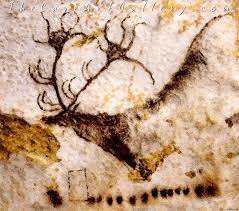
The paintings discovered by teenagers in 1940 had been dated to approximately 17,000 years ago, placing them firmly in the Upper Paleolithic period. But Gurdjieff disagreed with this timeline entirely. He believed the art represented survivors of a catastrophic event that had destroyed an ancient advanced culture, possibly dating back 7,000-8,000 years or even earlier.
Standing before the famous images, Gurdjieff offered his own interpretations: the stag with many antlers represented “attainments in consciousness and being,” while certain imaginary creatures served as emblems of ancient brotherhoods and mystery schools.
To him, these weren’t merely the artistic expressions of hunter-gatherers but deliberate “legominisms”—intentionally encoded information designed to transmit esoteric knowledge across millennia.
Cro-Magnons at Lascaux
The people conventionally credited with creating the Lascaux paintings—and hundreds of other cave art sites across Europe—are known as Cro-Magnon, named after the rock shelter in Dordogne, France where their remains were first discovered in 1868. This discovery represented a watershed moment: for the first time, scientists had found anatomically modern humans (Homo sapiens) dating to the Prehistoric period.
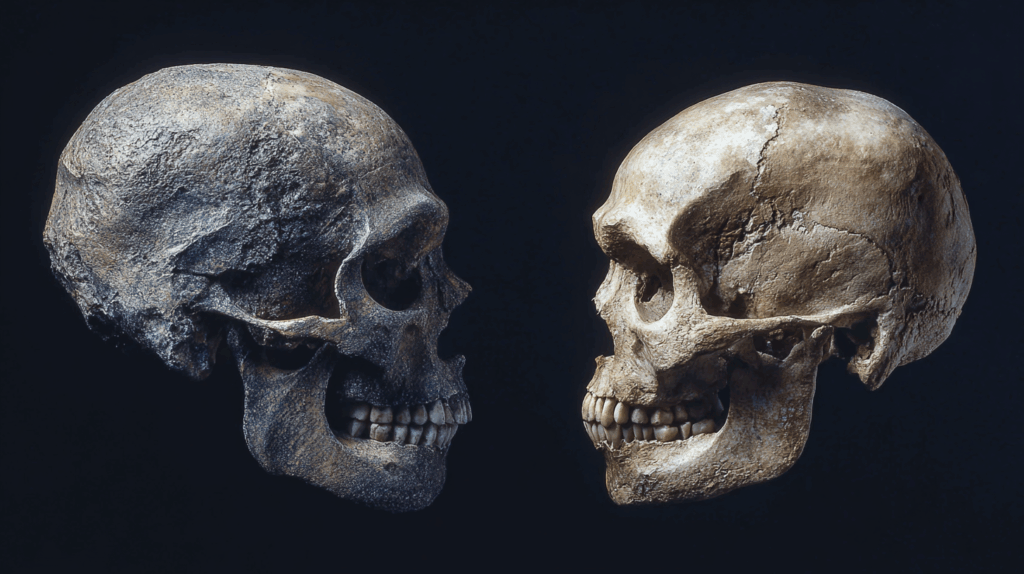
Contrary to the image of primitive “cavemen,” Cro-Magnon people rivaled modern humans in size and possibly intelligence!
- They were approximately 166-171 cm (5’5″ to 5’7″), comparable to or taller than modern averages
- Their brains were about 1,600 cubic centimeters, significantly larger than the modern human average of 1,350 cc
- They were generally heavy and solid with strong musculature, thicker and more robust bones than modern humans
- They had high foreheads, prominent chins, relatively flat faces with gracile brow ridges
The Cro-Magnon 1 skull, the type specimen discovered in 1868, possessed a cranial capacity exceeding 1,700 cubic centimeters, making it one of the largest known human brains in the fossil record. Using modern 3D scanning technology, researchers created a detailed endocast (brain replica) revealing that this 28,000-year-old brain was 15-20% larger than our brains today.
Are Humans De-Evolving?
This raises a profound question: why have human brains been shrinking over the past 20,000-30,000 years?

Scientists propose several theories:
- Smaller brains may actually be more efficient, using less energy while maintaining or improving cognitive function
- As food became easier to eat (less raw meat, more cooked and processed foods), we no longer needed massive jaws and skulls to support powerful chewing muscles
- As human societies became more complex and interdependent, individual brain size may have mattered less than collective intelligence
Detailed analysis of the Cro-Magnon brain shows it had a smaller cerebellum (linked to motor control and language) than modern humans, but longer frontal lobes and taller occipital regions. Whether this translated to functional cognitive differences remains unknown.
Cro-Magnon’s Place in Human Evolution
Cro-Magnon people were anatomically modern humans—the same species as us (Homo sapiens), which is why modern scientists prefer “Early European Modern Humans” (EEMH) over Cro-Magnon.
Regardless of the term used to describe them, these people represented the first wave of modern humans to successfully colonize Europe, arriving between 45,000 and 56,800 years ago from Western Asia. They encountered and coexisted with Neanderthals (Homo neanderthalensis) for approximately 12,000-15,000 years before the latter went extinct around 30,000-40,000 years ago.
Did Cro-Magnons Breed with Neanderthals?
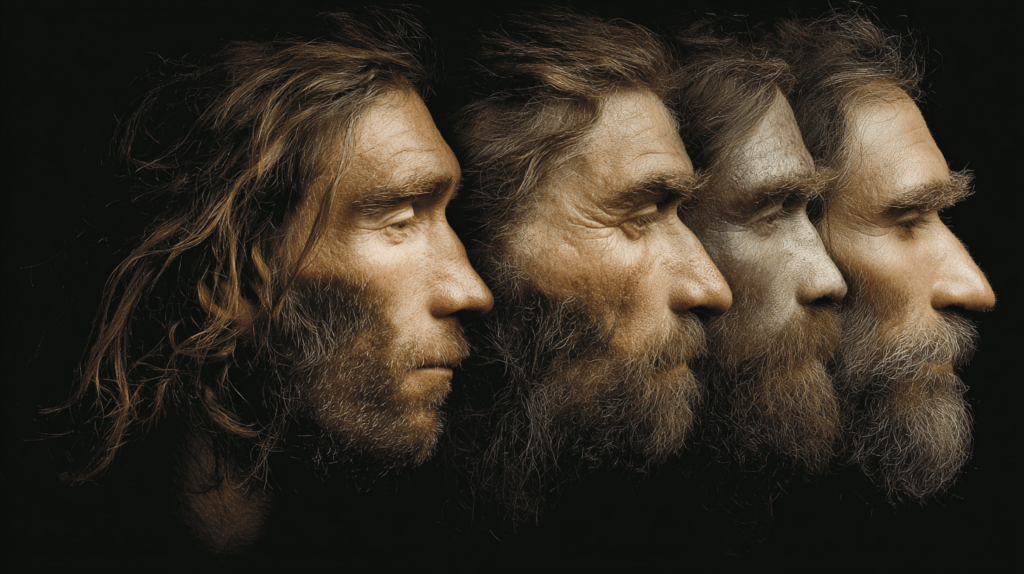
For decades, scientists debated whether Cro-Magnon and Neanderthals interbred. A 2008 study sequencing mitochondrial DNA from a 28,000-year-old Cro-Magnon individual (Paglicci 23) found no trace of Neanderthal DNA, supporting the extinction theory over the admixture hypothesis.
However, more recent genetic evidence has complicated this picture. Modern non-African humans carry approximately 2% Neanderthal DNA, indicating that some interbreeding did occur, though far less than previously estimated. Computer simulations suggest the actual rate of interbreeding was only about 0.1%, or roughly 400 times lower than earlier estimates.
The Paglicci 23 individual’s DNA sequence was the Cambridge Reference Sequence, a mitochondrial DNA pattern still common in Europe today. This demonstrates “genealogical continuity across 28,000 years, from Cro-Magnoid to modern Europeans”.
Skin Color and Adaptation
Contrary to long-standing assumptions, early Cro-Magnon people did not have pale European skin. Genetic analysis reveals that the genes responsible for lighter skin (SLC24A5 and SLC45A2) and lighter hair and eyes (TYRP1) underwent positive selection as recently as 11,000-19,000 years ago—long after Cro-Magnon first arrived in Europe.
The delayed evolution of pale skin likely resulted from low population densities and limited cross-continental movement required for such adaptive shifts. The KITLG gene, however, began experiencing positive selection around 30,000 years ago.
Cro-Magnons, Inner Earth, and the Magnetic Field Collapse
One of the most intriguing correlations in recent research links Cro-Magnon cave use to catastrophic weakening of Earth’s magnetic field.
The Laschamps Excursion

Approximately 41,000 years ago, Earth’s magnetic field underwent a dramatic collapse known as the Laschamps excursion. During this period:
- The magnetic field strength dropped to about 10% of modern values
- The magnetic poles shifted dramatically—at one point, the dipole axis was tilted 76 degrees to the geographic axis
- Earth’s magnetosphere resembled those of outer planets like Neptune
- Auroras would have been visible throughout Europe and Northern Africa, not just near the poles
Human Response: Seeking Shelter
When researchers mapped areas affected by the weakened magnetic field against archaeological evidence, they found striking correlations:
- Dramatic increase in cave use around 41,000 years ago
- Increased use of ochre—a natural mineral that functions as effective sunscreen
- Development of more sophisticated clothing
“We found that many of those regions actually match pretty closely with early human activity from 41,000 years ago, specifically an increase in the use of caves and an increase in the use of prehistoric sunscreen,” explained researcher Agnit Mukhopadhyay.
The weakened magnetic field allowed cosmic radiation and energetic solar particles to penetrate Earth’s atmosphere, making surface living far more dangerous. This may explain the extensive cave occupation during this period—not cultural preference, but survival necessity.
Not True “Cave Dwellers”
Despite this period of intense cave use, Cro-Magnon were not stereotypical “cavemen”. They were intelligent, with archaeological evidence that reveals:
- Construction of semi-permanent houses and structures
- Sophisticated social organization with community support systems (evidenced by individuals surviving severe injuries like skull fractures and fused vertebrae)
- Complex burial practices including grave goods like shell necklaces
- Advanced artistic expression including cave paintings, carved bones, and personal ornaments
The story of Cro-Magnon—and Gurdjieff’s interpretation of their art—challenges the simplistic “primitive Stone Age to advanced civilization” progression.
Consider the evidence…modern humans have smaller brains than our Cro-Magnon ancestors and the evidence we do have of them shows remarkable sophistication:
- Complex adhesives from tree resins (thermoplastics)
- Precision stone tools requiring years of training
- Sophisticated artistic traditions including cave paintings, carved figurines, and musical instruments
- Advanced knowledge of astronomy, animal behavior, and plant properties
- Medical care (individuals surviving severe injuries)
- Burial rituals with grave goods
- Long-distance trade networks (shells found hundreds of kilometers from ocean)
- Symbolic thought and abstract representation
But this may just be scratching the surface.

We must acknowledge the massive preservation bias in the archaeological record. Organic materials that dominated Cro-Magnon life, such as wood tools, plant fiber cordage, leather clothing, herbal medicines, have all vanished completely, leaving only the most durable 1-5% of their materials.
What would remain of our civilization after 30,000 years?
- Steel buildings would be rust
- Electronics would be dust
- All buildings would be gone
Only stone monuments, some ceramics, and perhaps a few gold artifacts would survive, creating the illusion that we were a “primitive Stone Age culture” to future archaeologists.
When we look at the Cro-Magnons and their seeming evolutionary advantages over modern man, one begins to wonder whether modern man actually is the pinnacle of civilization.
After all, within a few thousand years, nature either buries or destroys everything man creates.
We didn’t even know the Olmecs existed until recently, and there is evidence pointing towards a civilization predating Egypt.
Given the mounting evidence that points towards lost and buried civilizations, it’s almost certain unknown civilizations existed…perhaps for tens of thousands of years, if not longer.
Gurdjieff’s Vision: Encoded Ancient Knowledge
Gurdjieff’s interpretation of Lascaux gains new resonance when we consider these facts. He believed ancient humanity possessed sophisticated knowledge that were intentionally encoded in art, architecture, and ritual to survive over long stretches of time.
His concept of “legominisms”—information deliberately embedded in art—suggests that what we interpret as simple animal drawings might actually point towards more complex teachings that contained astronomical, mathematical, or spiritual knowledge.
The stag with many antlers as “attainments in consciousness”—could this reflect actual shamanic traditions where antlers symbolized altered states or spiritual hierarchies?
The imaginary creatures as emblems of ancient brotherhoods—do these represent totem animals of specialized knowledge lineages, similar to what anthropologists find in surviving indigenous cultures?
In short, what remains of ancient religions may be analogous to what remains at ancient archaeological sites: mere traces.
Conclusion: Reconsidering Human History
The Cro-Magnon story challenges us to reconsider assumptions about “primitive” ancestors.
When Gurdjieff stood in Lascaux in 1949, perhaps he recognized something modern archaeology is only beginning to acknowledge: that human capability, intelligence, and sophistication extend far deeper into the past than our civilization-centric narratives admit.
The “Cro-Magnon” label itself has been retired by science, replaced by the recognition that these were simply early modern humans.
They were people with the same cognitive abilities, emotional range, and creative potential as anyone alive today. Their larger brains and robust bodies suggest that human evolution is not a simple upward trajectory but an as-yet-unknown story of adaptation, loss, and change.

As we face our own environmental challenges, including concerning declines in Earth’s magnetic field strength over the past 180 years, the Cro-Magnon experience of surviving catastrophic geomagnetic collapse offers both warning and hope.
They adapted, they created, they thrived, and they left behind art that still speaks to us across 17,000 years.
Put together, the sophistication of Cro-Magnons sophistication and Gurdjieff’s interpretation suggest that very ancient humans may have held advanced forms of inner knowledge and symbolic systems, far earlier than the usual Mesopotamia‑centered “civilization timeline” admits
Perhaps Gurdjieff was right.
Encoded in those caves lies forgotten wisdom from forgotten ancestors, telling us about a long lost chapter of our human history…one that could be far older and far different from the one we think we know.